

In 2024, BEF received a $10,000 GROW Grant from Advantis Credit Union to support student-run businesses in Beaverton School District high schools. BEF invited student-run businesses to submit proposals for seed funding to launch or grow these businesses. BEF boosted programs at three schools that offer innovative, career-connected learning opportunities for students and worked with a fourth school to get custom printed book bags for our Summer Boost program.
Beaverton Academy of Science and Engineering’s Engineering Tech Team
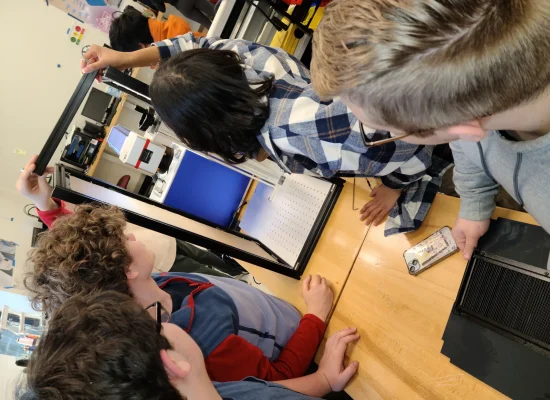
The “BASE” Engineering Tech Team is an afterschool program where students learn to use equipment such as CNC (computer numerical control) machines, laser cutters, embroidery machines and wide format and 3D printers. This afterschool program acts more as a student-run business with student teams receiving orders from the school community, then developing work plans, designs, and timelines. They write up invoices and track expenses. All with an eye toward meeting customers’ needs.
They wanted to add a fiber laser machine that would add another type of product line: etched metal products. Even with the funding to purchase the equipment, it took a lot of determination to get the laser calibrated. Then they faced delays getting safety equipment. They have limited work hours after school. These are the same challenges any startup might face: limited resources, delays, juggling other commitments. In essence, this project becomes a crash course in entrepreneurship.
Despite, or maybe because of the challenges, students stayed engaged throughout. You can hear excitement in what students said about their experience: “I like this. It gives me more opportunities to learn about current technology.” Another student added: “It’s been really fun to learn how to control the laser and make it work right. I am learning a lot of new skills, figuring things out through trial and error.” Their teacher, Amber Arizpe, summed it up perfectly: “It encourages students to learn new skills and also see that they can monetize those skills or that those skills can lead to bigger, more complex skills.”
This is exactly what BEF hopes career connected learning can do for students, helping them go beyond learning one skill to see how those skills can lead to something bigger, even to a career.
Southridge High School’s Hawk Shop
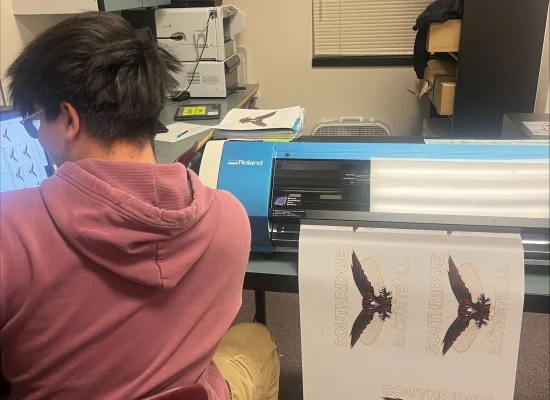
This collaborative student-run enterprise provides printing services to Southridge High School and the community. They wanted to invest grant funds in a vinyl printer and cutter, which gives access to new technology in demand by customers. Like the BASE Tech Team, the Hawk Shop team found calibrating the cutter to get the images cut just right was more difficult than anticipated. Students had come together to trouble shoot and problem solve, but didn’t give up, they kept refining their process. They also made tough decisions not to sell products until they were sure it met their – and their customer’s expectations for quality. They learned a key lesson in the process: there are always unexpected hurdles, but you can overcome them with hard work and resilience.
Their teacher, Kyle Chamberlain, gives all the credit to the students: “They are completely in charge of the Hawk Shop from training to project completion. They own it completely. They do a great job finding and working with clients and then producing the product on time and on budget. This is a student-run operation from start to finish and our students take a lot of pride in that fact!”
Sunset High School’s Makers’ Space
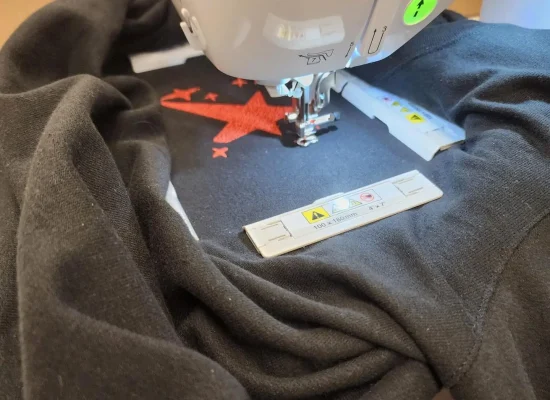
Another student business that received an investment is the Maker’s Space where art and entrepreneurship are combined. Students in Sunset’s Product Design class as well as members of two after school clubs use equipment in this maker’s space to design and create their artwork. The grant money here was used to buy equipment: a screen printer, embroidery machine, and smaller items that students can use to turn creative ideas into reality. The Maker’s Space also creates a platform for marketing and selling their work; one Maker’s Market was held this week with 20 artists participating, another is planned for the spring. Profits from sales are reinvested to help the Maker’s Space to become financially sustainable.
Participating in the Makers’ Market helps students connect art with business. One student: “I’ve always loved being artistic, but this market has let me explore the business side of making and selling, which makes it feel more real-life and less of a hobby. Now I feel like I have a good reason for spending my time on it!” A parent was enthusiastic as well: “my daughter is suddenly way more excited about school because of this opportunity.”
Beyond the fun of creating projects, the teacher advising Maker’s Market students used the upcoming sale to help students with project and time management skills. These aren’t skills taught in traditional art classes but are important if they want to get their products ready for sale on time. Teacher Cady Geer elaborated: “It’s inspiring to see these young people take ownership of an opportunity like this. I’ve seen real growth and maturity happen this semester and I’m excited to see how it benefits our school community as a whole.”
Westview HS Manufacturing CTE Program
For many years now, BEF has purchased book bags for the Summer Boost reading program from the Westview HS Manufacturing CTE program. Students at Westview HS learned to use a heat press in order to place the Summer Boost logo onto book bags. In the process, they learned technical skills as well as critical skills of project management, production schedule, quality control, and customer service.